
Dental Assisting Professional Model expands to orthodontic functions

The Dental Assisting Professional Model Workgroup announced new guidance for the orthodontic setting, offering a clear career path for the nearly 20,000 dental assistants considering or working in orthodontic practices.
The Professional Model offers a shared understanding of assistants’ roles and how they can advance professionally amid wide variation in how states regulate dental assisting. Such discrepancies affect recruitment and retention, which is particularly challenging in orthodontic settings, according to the American Association of Orthodontists.
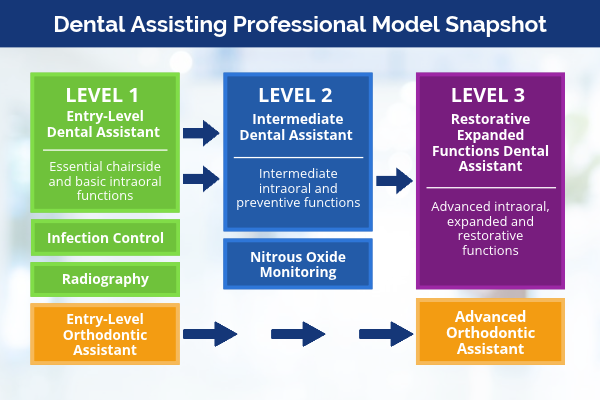
Orthodontic functions are now included in the Professional Model, along with associated training, education and credentials for both entry-level and advanced orthodontic assistants. The new guidance was issued following months of collaboration and stakeholder feedback.
“Before the Dental Assisting Professional Model was released last year, dental assistants lacked national guidance on their scope of practice as well as a clear pathway to career advancement,” said Dolores Cottrell, D.D.S., M.S.H.A., the group’s co-chair and former executive secretary for the New York State Board for Dentistry. “The model now gives dental assistants in general dentistry and orthodontics a framework to build rewarding careers, expand their professional opportunities, and gain recognition for their essential role in oral health.”
The Workgroup convened 10 dental professionals to build the orthodontic guidance — including three Certified Orthodontic Assistants and two orthodontists nominated by the American Association of Orthodontists and American Academy of Pediatric Dentistry.
States can adopt the framework across levels, descriptions, tasks, education, and credentials. This might include using the model to update or modify existing levels, create a new orthodontic assistant level, or adjust functions allowed in each level. Employers, including dentists and dental service organizations, can create training guides or develop pathways to promotion using the model.
“Lack of uniformity makes recruiting and retaining qualified professionals a persistent challenge,” said Helen Sublette, CDA, COA, CDIPC, FADAA, B.S., co-chair of the Workgroup and owner of Coastal Dental Professionals Consulting. “Focusing on the unique needs of orthodontic settings and orthodontic assistants brings this important role to the forefront and lays a foundation to recognize competency, create pathways for professional growth, and elevate the individuals whose knowledge and skills are essential to patient care. When we invest in dental assistants, we strengthen the profession, expand opportunities, and help shape the future of oral healthcare.”
Eleven leading organizations have endorsed the Dental Assisting Professional Model, including the American Association of Dental Boards, American Dental Assistants Association, American Dental Education Association, American Network of Oral Health Coalitions, Association for Dental Safety, Aspen Dental, D&D Dental Consulting, Dental Assisting National Board, Imagine Orthodontic Studio, Pennsylvania Coalition for Oral Health, and Wyoming Professional Training.
Trapezio, the endorsed staff training program for the American Association of Orthodontists, and Depew Orthodontics were the two most recent organizations to endorse the orthodontic framework.
“Orthodontic assistants are central to how our practices run and they deserve a clear path to grow in their careers,” said Doug Depew, D.M.D., M.S., founder and academic director of Trapezio and a Workgroup member. “Trapezio is endorsing this national model because it gives the profession a career path that benefits dental assistants, practices, and patients.”
To learn more about the model, how it can be used, or how to endorse it, please contact Michelle Lee.