
How educators are building the future of dental assisting

Dental assistant educators play a vital role in educating and empowering the next generation of dental assistants. However, with a shortage of qualified educators seen in some areas, their role is even more critical. As we celebrate Dental Assistants Recognition Week (DARW) March 1-7, we recognize the dental assistant educators who are helping to build the future of the profession.
An in-demand career
While there are many benefits to a career in education, some dental assisting educational programs are reporting challenges with hiring qualified dental educators.
Dental assistant educator Mark Matney, CDA, CPFDA, RDA, FADAA, B.S., stresses that not only is teaching a rewarding career, it’s one that is in demand. “The first thing that comes to mind is, there’s a need there,” he says. “There is a demand for educators.”
Matney is addressing the apparent shortage by starting conversations about the importance of teaching. He makes sure dental assistant students know that by becoming educators, they can make an incredible impact on the future of the profession.
“I do the best I can to encourage and mentor those who may want to explore that pathway,” elaborates Matney, the dental assisting program director at Chattanooga State Community College in Tennessee. “I’ll say, ‘You never know when I might have a part-time or full-time position open, here’s the requirements for what you need, keep it in the back of your mind. Keep learning, keep going, and keep in touch with us about what you’re doing if you’re interested in instructing.’”
Similarly, program director Sarah Norris, CDA, M.S., starts by tapping into her network when hiring for the dental assisting program at ATA College-Louisville in Kentucky. She leverages local connections — at school, in her community, at the local dental offices where she occasionally works chairside — for the perfect candidate.
Reasons behind the shortage
From Matney’s perspective, the shortage he’s seeing is likely due to longtime dental assistant educators retiring, and because some applicants may not yet be fully qualified to fill their shoes.
“Finding qualified educators in central Florida is nearly impossible,” agrees Denise Murphy, CDA-Emeritus, CPFDA-Emeritus, CRFDA-Emeritus, CDPMA-Emeritus, B.A., who retired in August 2025 after working for more than 40 years as an instructor at Orange Technical College in Florida.
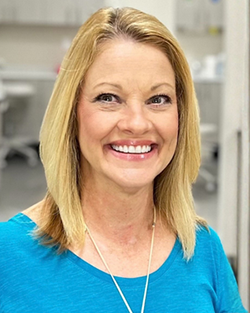
“I used to say, ‘I feel like an NFL athlete or NBA player who is getting paid millions to do something that I love.’ That’s why I stayed in education for so long, because of that passion.”
— Denise Murphy
Murphy notes that it took almost eight months to find her replacement. When seeking candidates to fill her role, Murphy reached out to alumni to ask if they were interested in applying, but she found that many had either left dental assisting or wouldn’t qualify for the teaching role. In most cases, the graduates she screened didn’t meet the educational requirements in the instructor job description.
To teach at a dental assisting program that is accredited by the Commission on Dental Accreditation, a dental assistant educator typically needs a bachelor’s degree, though not necessarily in dental assisting. But qualifications can vary — in Florida, for example, an educator at an accredited dental assisting program must have a bachelor’s degree, current Certified Dental Assistant (CDA) certification, a Florida expanded functions certificate, and a minimum of three years of experience in clinical chairside assisting.
Bringing passion to the classroom
Perhaps Murphy says it best when she describes educators as “playing a huge role in the training and success of future credentialed dental assistants.” Because educators are vital to shaping the profession, the right energy and attitude are essential.
Norris prioritizes hiring and training qualified dental assistants who also “can teach well,” which she says requires enthusiasm. “First and foremost, you have to have a passion for what you’re teaching about, right? If you don’t, it’s not going to be effective,” she explains.

“My favorite thing is and always will be watching students and graduates realize their own potential.”
— Sarah Norris
“I’ve been educating for 10 years,” Norris continues. “It’s very rewarding, certainly. In any career, that’s key. Having that sense of accomplishment, and that excitement about getting up in the morning, is crucial to being effective in whatever you’re doing.”
Similarly, Murphy is grateful to have spent the majority of her career as a full-time dental assistant educator, after working for 14 years as a dental assistant with a part-time teaching role. “I used to say, ‘I feel like an NFL athlete or NBA player who is getting paid millions to do something that I love,’” Murphy says. “That’s why I stayed in education for so long, because of that passion.”
Matney’s passion for dental assisting, along with his interest in helping others, also led him to the classroom. “I was thinking, ‘I want to do something in healthcare, and dental assisting seems pretty cool,’” he reflects. “I’ve always enjoyed working with people and felt I have good teaching qualities.”
Key qualities of being an educator
Beyond being experts in their field, teachers need to think critically, communicate clearly, build relationships, and exhibit patience and resourcefulness.
Norris would add adaptability to the list. “Teaching involves a lot of thinking on your feet,” she says. “It involves having a robust knowledge of the topic and how students learn so that you can deliver your explanation in a variety of ways.”
Additionally, educators should demonstrate leadership, says Matney: “An educator must have leadership qualities, patience, push students to do their best, be open to changes in technology, and think outside the box.”

“An educator must have leadership qualities, patience, push students to do their best, be open to changes in technology, and think outside the box.”
— Mark Matney
For students and teachers alike, continued learning is also vital — especially when it comes to artificial intelligence (AI), which is emerging in both the classroom and dental office. “To be an effective educator, you have to be a lifelong learner and be willing to continuously evolve, because teaching is continuously evolving, just like dentistry,” says Norris.
“I mean, it’s just cool,” continues Norris, of both learning and teaching about dental assisting. “That’s the best way I can put it. It’s rewarding. It’s challenging in all of the ways that you’d love something to be challenging. It’s ever-evolving, and there’s an artistry to it that I find fascinating.”
Educators agree it’s especially rewarding to watch students’ educational and professional journeys unfold, steering them toward careers in the dental office, classroom, and beyond, to other unexpected career paths for dental assistants. For example, Matney’s favorite part of teaching is when students grasp the content and become confident. “They’ll say, ‘Now I finally see why everything we’ve learned so far is so important!’ It’s like a light switch,” he says.
Often, it takes multiple lessons and activities to reach this point. “Sometimes, we just need to take a break and come back to it. That can make a world of difference,” says Matney.
Murphy also acknowledges that not everyone has the patience to help students navigate their learning styles. “Teaching is not for everybody,” she says. “But watching students put the connection together between the book knowledge and the practical experience was very rewarding.”
“My favorite thing is and always will be watching students and graduates realize their own potential,” echoes Norris. “They come into the program and have this spark, an interest in dentistry, a willingness to better themselves, but they don’t realize what they can do. Dental assistants are the backbone of the dental practice, the grease to the wheel, often the first point of contact for the patient, and the calm to their storm.”
Murphy agrees that dental assistants are the heart and soul of the practice. Since she began working as an instructor over four decades ago, she has enjoyed helping students find success. “I love watching their enthusiasm and excitement for dentistry grow,” she says. “It’s just like watching a garden bloom.”
Ways to become an educator
Norris has observed some candidates lack the credentials for a formal teaching position, but she believes mentorship can help close that gap. “The key is to find individuals who are capable and passionate about dental assisting, and then to give them the tools to teach,” she says. Dental assistants who are interested in becoming an educator should research the required education and credentials for dental assistant teaching roles in the state or area they plan to apply. Additionally, candidates should consider whether they’re interested in working at a high school, non-accredited, or accredited post-secondary program, since requirements may depend on the program’s type and level. If additional qualifications are needed, some schools offer reimbursement for aspiring educators who plan to work at their school. Scholarship opportunities from organizations such as DANB and the DALE Foundation can also help offset the cost of school and credentialing.
Networking with current or former teachers and employers could make all the difference in finding job opportunities, including in education. Aspiring teachers also might consider earning and maintaining DANB certification, as well as joining the American Dental Assistants Association (ADAA), the American Dental Education Association (ADEA), and similar organizations that connect dental professionals and provide support and camaraderie.
Norris knows firsthand that making the switch can happen, and that becoming an educator can be a rewarding career change for any dental assistant who is interested in helping shape the next generation of the profession. Norris herself transitioned to teaching after receiving encouragement from dental teachers, mentors, and teammates who recognized her potential.
“During my time as a dental assistant, I trained a lot of people,” she recalls. “Several came to me and said, ‘you need to teach.’ I am so very thankful that teaching became another passion and it’s something that I love to do.”